How to Speed Up Rapid Diagnosis of Drainage Problems

Last Updated: 22 November 2026
Quick Summary
Rapid diagnosis of drainage problems means identifying the cause of a fault, not just the symptom, within hours rather than weeks. We combine symptom triage, camera inspection and a written condition report so repair decisions rest on evidence. This prevents small faults escalating into structural damage and costly emergency call-outs.
- Treat flooding near electricals, sewage backup or a visible collapse as urgent and escalate immediately.
- Commission a CCTV survey after two or more blockages in the same line within 12 months.
- Ask for MSCC5 coding, defect locations and urgency-ranked recommendations in every survey report.
- Clear gullies quarterly and commission a full CCTV condition assessment annually.
- Track time to attendance, time to diagnosis and repeat-blockage rate per line as KPIs.
Table of Contents
- Why Rapid Diagnosis of Drainage Problems Matters for Facilities Teams
- Drain Blockage Symptoms Your Team Can Spot Before Calling Anyone
- When to Commission a CCTV Drain Survey for Commercial Buildings
- What a Useful Drainage Survey Report Must Include
- Building Planned Drainage Maintenance for Facilities Management
- Booking a Diagnostic Survey With Agreed Scope and Pricing
- Frequently Asked Questions
Why Rapid Diagnosis of Drainage Problems Matters for Facilities Teams
A 2015 study in Building and Environment on detecting and diagnosing faults in building drainage systems found that systematic evaluation methods let facilities teams catch drainage faults before they escalate into structural damage.
Rapid diagnosis of drainage problems for facilities management is the practice of identifying the cause of a drainage fault, not just the symptom, within hours rather than weeks.
Why does speed matter so much? Because drainage faults rarely stay still.
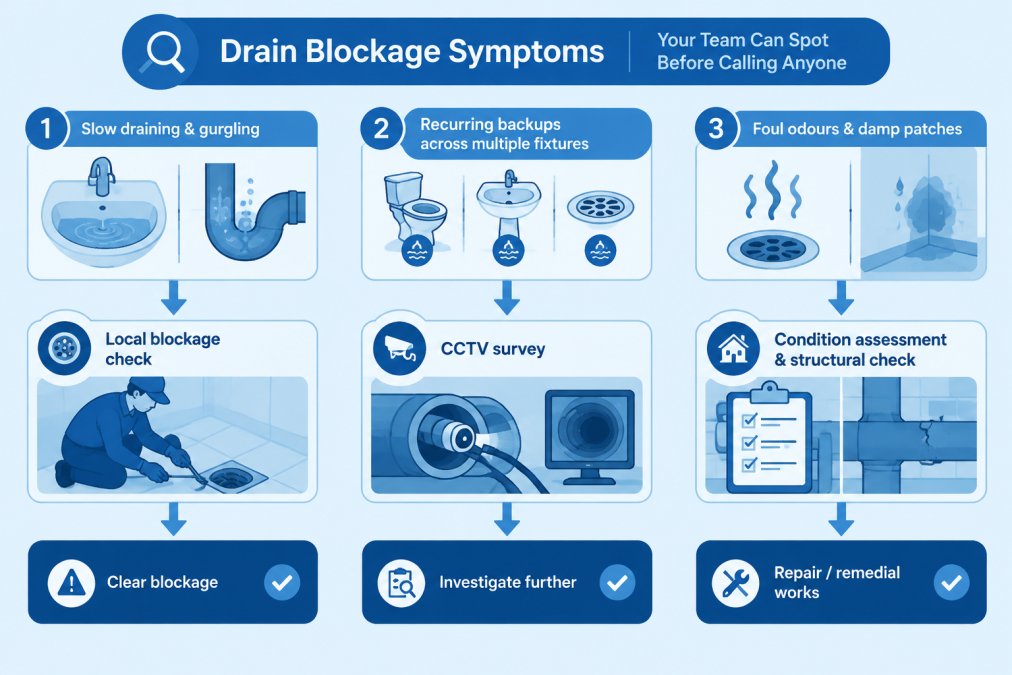
Drain Blockage Symptoms Your Team Can Spot Before Calling Anyone
Most blockages announce themselves well before the first overflow. Teaching staff what to look for buys you hours of warning. If you want the fuller pre-call checklist for staff, see our guide on what to do before you call a drain blockage plumber.
Symptom-to-Cause Diagnostic Guide
Use the table below to move from observation to likely cause and the right next step. It is not a substitute for a professional diagnosis, but it helps your team ask better questions and escalate with confidence.
| Symptom | Likely cause | Safe check | Escalation trigger |
|---|---|---|---|
| Slow draining in one sink or basin | Local partial blockage in trap or branch | Remove and clean trap; check for debris | If slow drainage persists after trap clean, book a CCTV survey |
| Gurgling sounds from traps or toilets | Partial blockage or venting issue | Note which fixtures gurgle and when | If gurgling occurs across multiple fixtures, commission a survey |
| Recurring blockages in the same line | Structural defect, root intrusion or misalignment | Log dates and affected fixtures | After the second recurrence, request a CCTV condition assessment |
| Foul odours in one room | Dry trap or local waste issue | Run taps to refill traps; check for leaks | If odour persists or spreads, arrange a drainage inspection |
| Foul odours across multiple rooms | Ventilation or system-wide issue | Confirm whether traps are dry | Escalate as a potential health risk; call a specialist |
| Localised flooding or pooling | Blockage, collapse or infiltration | Check external gullies for debris | If flooding is near electricals or walkways, treat as urgent |
| Damp patches or mould on walls | Leaking drain or infiltration | Note location and spread | Arrange a condition assessment; do not delay |
Safe Checks Staff Can Do Before Specialist Attendance
- Note which fixtures are affected, and whether the problem is one sink or every drain on the floor
- Watch water levels in sinks and toilets as they drain; slow falls point to a partial blockage
- Check external channel drains and gullies for debris, leaves and silt
Staff should leave manhole covers, rodding and chamber entry to qualified engineers, as confined spaces can hold harmful gases. A common mistake is clearing the visible blockage and stopping there. The real question is why the drain blocked, and whether it will block again.
Emergency Prioritisation and Escalation Criteria
Not every drainage problem is an emergency, but some are. Use these triggers to decide whether to call for immediate attendance or log a routine job.
Treat as urgent and escalate immediately if:
- Flooding is near electrical equipment, distribution boards or walkways
- Sewage is backing up into the building
- There is a strong, persistent smell of gas or hydrogen sulphide
Log as routine if:
- Slow drainage is isolated to one fixture and no flooding is present
- A single trap is dry and refilling it resolves the odour
- A gully is blocked with leaves but water is draining elsewhere
When in doubt, err on the side of caution. A rapid diagnosis is cheaper than a closed facility.
When to Commission a CCTV Drain Survey for Commercial Buildings
Commission a CCTV drain survey for commercial buildings when symptoms recur, when a property changes hands, or when a repair recommendation needs evidence behind it. A camera inspection is the only way to see pipe condition without excavation, and it turns guesswork into a documented diagnosis. You can see the condition and code the evidence with a professional CCTV drain survey when your team reaches that point.
Triggers for Commissioning a Survey
Use these triggers to decide when a CCTV survey is the right next step rather than another round of clearing:
- Repeat blockages: two or more blockages in the same line within 12 months
- Multiple symptoms: gurgling, slow drainage and odours affecting more than one fixture
- Property changes: acquisition, disposal or major refurbishment
What Camera Inspection Reveals That Manual Checks Cannot
Manual inspection shows you a wet floor. A camera shows you why. According to a 2026 study in the Journal of Environmental Management using CCTV inspection data to map drainage defect patterns, defects cluster in predictable combinations, which means an inspector who knows the patterns can flag a failing line before it collapses. Camera work exposes cracked pipes, collapsed drains, root intrusion, pipe misalignment, infiltration and debris build-up.
Defining the Survey Scope
Before you book, agree the scope in writing. A typical commercial survey should specify:
- Which lines are included (and which are excluded)
- Access points to be used and any confined-space requirements
- Whether the survey is condition-only or includes root-cause investigation
Watch out: an open-ended scope can lead to unexpected costs. Ask for pricing to be agreed clearly and in writing before the survey begins.
Evidence and Handover Requirements
After the survey, request the following as standard:
- CCTV footage for each line, with time stamps
- Defect locations referenced to manhole numbers or chainage
- Severity ratings using MSCC5 codes
This evidence pack is what turns a survey into a defensible maintenance decision. Without it, you have a video, not a diagnosis.
What a Useful Drainage Survey Report Must Include
A useful drainage survey report states the pipe condition in plain terms, codes every defect, and recommends a repair with evidence attached. Anything less is a video with commentary.
The report should cover:
- Line-by-line condition with MSCC5 codes and severity ratings
- Root cause identification, not just a description of the blockage
- Repair recommendations ranked by urgency
When the report lands, it should feed straight into an evidence-led repair plan. Our page on evidence-led drain repairs and pipe replacement explains how findings translate into targeted repair, excavation or root cutting rather than open-ended work.
Building Planned Drainage Maintenance for Facilities Management
Planned drainage maintenance for facilities management is a scheduled programme of preventative inspection, drain cleaning and condition assessment that runs alongside reactive maintenance. FacilitiesNet reports that proactive drain cleaning prevents costly facility damage by finding build-up before it disrupts operations. The aim is fewer emergency call-outs, not more paperwork.
A workable schedule for most commercial sites:
| Activity | Frequency | Owner |
|---|---|---|
| Gully and channel drain clearing | Quarterly | Facilities team |
| Full CCTV condition assessment | Annually | Specialist contractor |
| Pump and attenuation tank check | Every 6 months | Specialist contractor |
| Root-cause review of repeat blockages | After every second recurrence | Facilities manager |
Response-Time and Diagnosis KPIs to Track
Measure the programme with four numbers: time from report to attendance, time from attendance to diagnosis, repeat-blockage rate per line, and percentage of faults diagnosed without excavation. If repeat blockages climb, the cause was never identified. That is the difference between clearing a drain and diagnosing a drainage system.
Booking a Diagnostic Survey With Agreed Scope and Pricing
Book a diagnostic survey only once the scope and price are confirmed in writing. Before you compare quotes, our breakdown of emergency drain unblocking costs and survey prices shows what call-out fees and out-of-hours rates typically involve.
Watch out: an unqualified engineer may miss critical problems, and a missed defect can cost far more later than the survey itself.
If a blockage is already backing up, get the right response fast with blocked drain diagnosis and clearance rather than waiting for a scheduled visit.
Drainage faults reward speed and evidence, and punish guesswork. If your team is managing recurring blockages without a clear picture of pipe condition, start with a proper diagnosis rather than another clearance.
Frequently Asked Questions
How can facilities managers diagnose drainage problems quickly?
Start with a symptom log: note which fixtures back up, whether the issue is local or building-wide, and how often it recurs. Check for safe, visible signs such as slow draining or water pooling near channel drains. Then commission a CCTV drain survey rather than repeated clearing, because camera inspection identifies the cause, not just the blockage. A structured triage approach, rather than guesswork, is the more reliable way to diagnose drainage faults.
When should a facilities manager arrange a CCTV drain survey?
Book one when blockages recur in the same line, when a drain blockage symptom appears across multiple fixtures, or before any planned refurbishment. A CCTV drain survey for commercial buildings is also worth commissioning when you need evidence for a repair recommendation or a condition assessment for insurance or handover. Drainamic only recommends a survey where the footage will change the decision, and every report is MSCC5-coded so the findings stand up in negotiations.
What should a drainage survey report include to be useful?
A usable drainage survey report should show MSCC5 structural and service condition codes, the location and severity of each defect, and photographs or video stills tied to the line references. It should explain findings in plain English alongside the technical coding, and set out repair recommendations with a clear scope. Drainamic only issues reports that a facilities team can act on without a second opinion, and we confirm the price before any work starts.
How can planned drainage maintenance reduce emergency call-outs?
Planned drainage maintenance for facilities management replaces reactive clearing with scheduled inspections and condition tracking. FacilitiesNet reports that regular inspections and scheduled maintenance help identify build-up and blockages before operational disruption, and a 2026 study in the Journal of Environmental Management showed that CCTV data can reveal recurring defect patterns across a network. Tracking those patterns lets you repair the cause, not just the symptom, and cuts repeat blockages.
